Industry
How Do Airplanes Fly? Lift, Thrust, and the Physics Explained Simply
8 min read

Love Aviation? Turn your passion into a career. Explore Aviation Maintenance Programs at AIM. Learn More
8 min read
A commercial airliner like the Boeing 747-8 can reach a maximum takeoff weight of 975,000 pounds. That mass of metal, fuel, luggage, and people still climbs to a cruising altitude of 35,000 feet and stays there for hours, as outlined in the FAA’s Pilot’s Handbook of Aeronautical Knowledge. The explanation comes down to four forces acting on the aircraft simultaneously: lift, thrust, drag, and weight. Each one pushes or pulls in a specific direction, and flight happens when all four reach a controlled balance.
According to NASA’s Glenn Research Center, every aircraft in flight has four forces acting on it at all times:
Steady flight occurs when these forces reach equilibrium: lift equals weight, and thrust equals drag.
Any imbalance between them causes the aircraft to accelerate, climb, descend, or slow down. Pilots control flight by deliberately adjusting this balance through engine power, control surfaces, and wing configuration.
Lift is the upward aerodynamic force that counteracts weight. It is generated primarily by the wings as they move through the air at speed. The shape of the wing and its angle relative to the oncoming airflow both manipulate air pressure to produce this upward force.
Air flowing over the wing splits into two streams:
The wing’s geometry causes the air pressure above the wing to drop lower than the pressure below it. That pressure difference pushes the wing (and the aircraft attached to it) upward.
Thrust is the forward force that moves an aircraft through the air. On jet-powered aircraft, thrust is generated by jet engines mounted on the wings or fuselage. Without sufficient thrust, the aircraft cannot reach the airspeed needed for the wings to produce enough lift to fly.
A jet engine operates through a four-stage process of intake, compression, combustion and exhaust:
The basic principle is the same as releasing an inflated balloon: gas rushes out one direction, and the object moves in the opposite direction. This is why aircraft need runways. The engines must accelerate the plane to a speed where the wings generate enough lift to overcome the aircraft’s weight before it can leave the ground.
Drag is the aerodynamic force that opposes an aircraft’s forward motion. It acts in the opposite direction of thrust, and every object moving through the air experiences it. The sensation of holding a hand out of a car window and feeling the air push against it is drag on a small scale.
Aircraft encounter two primary types of drag:
This is why aircraft are designed with smooth, streamlined fuselages, swept wings and retractable landing gear. Every external surface, bolt and antenna that disrupts airflow adds drag, which requires more thrust to overcome, which burns more fuel.
Weight is the force of gravity acting on the total mass of the aircraft, including the airframe, engines, passengers, cargo and fuel. Lift must equal or exceed weight for the aircraft to climb or maintain altitude.
Heavier aircraft need more lift, which requires either faster airspeed, larger wings or a higher angle of attack. A fully loaded Boeing 747-8 has a maximum takeoff weight of approximately 975,000 pounds. Generating enough lift for that mass demands long wings with a total area of roughly 5,500 square feet.
Weight also changes throughout flight. A long-haul aircraft can burn hundreds of thousands of pounds of fuel over a transatlantic crossing. As fuel burns off and the aircraft becomes lighter, it requires less lift and can climb to higher, more fuel-efficient altitudes.
This is why long-haul flights often cruise progressively higher as the journey continues.
An airfoil is the cross-sectional shape of a wing. Most airplane wings feature a curved upper surface and a flatter lower surface. This asymmetry forces air traveling over the top to move faster than air traveling underneath.
Bernoulli’s Principle states that faster-moving air exerts lower pressure. The curved upper surface accelerates airflow, reducing pressure above the wing relative to below it. Newton’s Third Law accounts for the wing deflecting air downward: the air pushes down, and the wing receives an equal and opposite force pushing it up.
Neither principle alone fully explains lift. Modern aerodynamics treats both the pressure differential and the downward deflection of air as contributing factors working together.
The angle of attack is the angle between the wing’s chord line (an imaginary straight line from the leading edge to the trailing edge) and the oncoming airflow. Increasing the angle of attack increases lift, because the wing deflects more air downward and creates a larger pressure difference.
This works only up to a critical threshold. According to the FAA’s Pilot’s Handbook of Aeronautical Knowledge, exceeding the critical angle of attack causes the airflow over the wing’s upper surface to separate and become turbulent. Lift drops sharply. This is called an aerodynamic stall, and it can happen at any speed or altitude.
Recovery requires reducing the angle of attack to reattach smooth airflow over the wing.
The FAA’s Pilot’s Handbook of Aeronautical Knowledge identifies multiple phases of flight, from preflight and taxi through climb, cruise, descent, approach and landing. Three of those phases best illustrate how the four forces shift relative to each other.
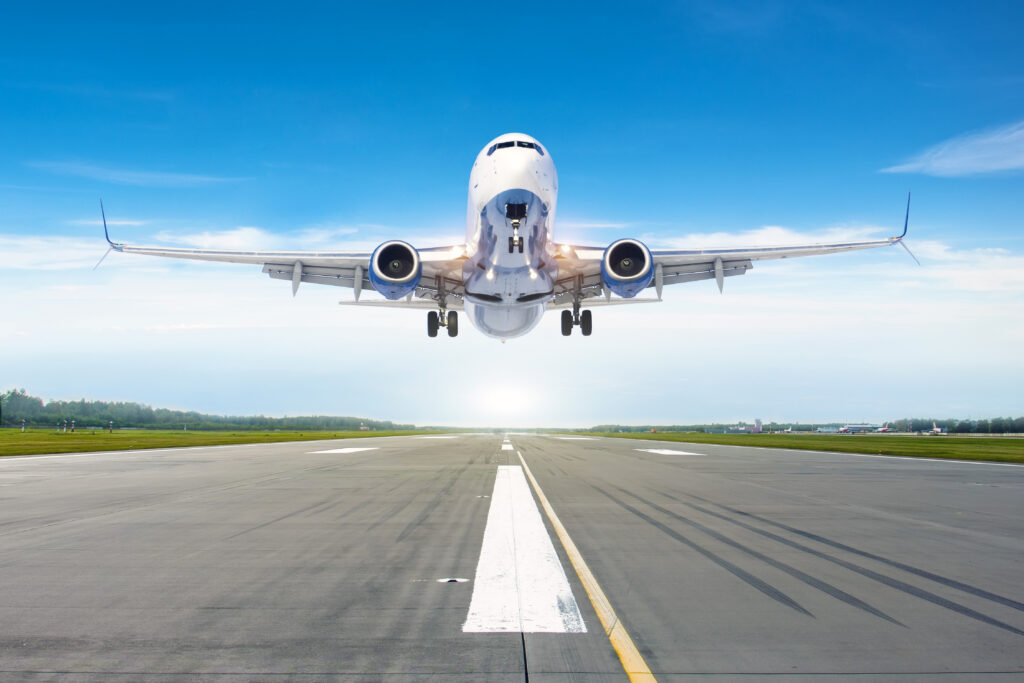
Takeoff requires thrust to exceed drag, accelerating the aircraft down the runway. As speed increases, the wings generate progressively more lift. Once lift exceeds weight, the aircraft rotates and climbs. Longer runways are required for heavier aircraft because they need more speed, and therefore more distance, to generate sufficient lift.
Cruise is the equilibrium state. Lift equals weight, and thrust equals drag. The aircraft maintains a constant altitude and speed. Pilots and autopilot systems make continuous small adjustments to maintain this balance as conditions like wind, temperature, and fuel load change.
Landing reverses the takeoff process. Pilots reduce thrust, which decreases speed. They deploy flaps and slats on the wings to maintain lift at lower speeds while increasing drag. As the aircraft descends on a controlled glide path, speed continues to decrease until the wheels touch the runway.
Spoilers on the wing surfaces then deploy to kill remaining lift and help the aircraft decelerate on the ground.
The entire flight envelope operates as a balance system. Every input, from engine throttle to control surface deflection, shifts the relationship between these four forces.
Engines provide thrust, not lift. Wings generate lift. If both engines fail on a modern airliner, the aircraft does not drop out of the sky. It becomes a glider with a glide ratio.
According to the FAA, a typical commercial jet can glide roughly 100 miles from cruising altitude with no engine power.
The 2009 ditching of US Airways Flight 1549 on the Hudson River demonstrated this clearly. According to the National Transportation Safety Board’s accident report, both engines ingested large birds shortly after takeoff, resulting in near-total loss of thrust. The crew glided the aircraft to a controlled water landing. All 155 people aboard survived.
Downward deflection of air is one component of lift, but the pressure differential across the wing surface accounts for a large portion. Both mechanisms operate simultaneously, and neither alone explains the full aerodynamic picture.
Next time you’re at cruising altitude, the aircraft around you is held aloft by a carefully managed balance of four physical forces working together in real time.
© 2025 aviation.co All rights reserved.